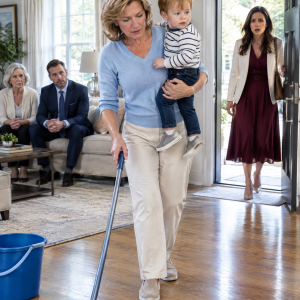
“How do you know?”
“Because Harrison called me this morning and ordered me to bring the boys there.”
Elliot immediately grabbed Noah’s hand.
Lauren looked at them.
“I’m not doing it.”
For the first time, her voice was firm.
“I’ve spent years being afraid of that man. Those children have already paid enough for the choices adults made around them.”
The House by the Lake
The Ashford estate stood behind iron gates overlooking Lake Michigan.
I had not returned since my father’s memorial.
Miles contacted federal investigators while I drove there.
Lauren had given us the service entrance code and explained that an unused section beneath the west wing had been converted into private rooms.
We found Hannah there.
She was lying in a bed, weak and exhausted, but awake.
Noah saw her first.
“Mom!”
Both boys ran to her.
Hannah wrapped her arms around them.
I remained near the doorway.
For the first time in my life, I felt like an outsider in a family that should have included me.
Eventually, Hannah looked up.
Our eyes met.
“You came.”
My throat tightened.
“Six years too late.”
She did not protect me from the truth.
“Yes.”
I nodded.
“I believed the version of events that demanded the least from me. I should have searched harder.”
Hannah studied my face.
“An apology doesn’t give them those years back.”
“I know.”
“Then don’t promise me anything.”
She looked at Elliot and Noah.
“Promise them through what you do next.”
Before I could answer, a familiar voice came from the hallway.
“Beautiful speech.”
My father stepped into the room.
He looked older and thinner, but unmistakably alive.
His eyes moved toward the boys.
“So these are my grandsons.”
I stepped between him and the bed.
“Don’t call them that.”
His expression hardened.
“Everything you have exists because of me.”
I looked at Hannah.
Then at my sons.
“That’s the problem. I spent too many years believing you.”
The Day the Empire Stopped Mattering
Hannah had already hidden copies of financial records where Miles could access them.
By the time my father realized what was happening, investigators were arriving at the estate.
He tried to regain control the way he always had—with names, money, lawyers, and threats disguised as advice.
This time, none of it worked.
As he was escorted from the property, he looked directly at me.
“When this is finished, you may lose everything.”
Years earlier, those words would have terrified me.
Now I looked past him toward the room where Hannah held our sons.
“No. I finally understand what everything means.”
Within days, Ashford Holdings entered an independent investigation.
I stepped down from my executive position.
People called it the collapse of an empire.
To me, it felt strangely like waking up.
The Life I Almost Never Had
Hannah needed months to recover her strength.
I did not ask her to forgive me.
Instead, I learned how to become useful.
I learned Noah hated the crust on sandwiches.
I learned Elliot loved astronomy but pretended he did not because another boy at school had once called it boring.
I learned which medication belonged in Noah’s backpack.
I learned how to make pancakes badly, then reasonably, then well enough that the boys stopped laughing at them.
Most of all, I learned that fatherhood was built from ordinary things.
Showing up.
Listening.
Remembering.
Keeping promises nobody else would ever applaud.
Nearly a year after Elliot and Noah first appeared in my lobby, we were living in a modest brick house outside Chicago.
One Saturday morning, Hannah stood beside the kitchen window watching the boys play in the backyard.
She had regained much of her strength.
We were not pretending the past had disappeared.
It hadn’t.
Some things should not disappear.
They should teach you.
Hannah looked at me.
“You understand that none of this erases those six years?”
“I understand.”
She nodded.
“Good. Because they don’t need you to erase the past. They need you to be here for what comes next.”
A second later, Elliot shouted through the open window.
“Dad! Noah says Franklin gets his own chair at dinner!”
Noah shouted back:
“He’s been through a lot!”
Hannah laughed.
So did I.
I walked outside.
For years, I had stood at the top of a company believing success meant becoming important enough that nobody could tell me what to do.
Two frightened boys carrying a worn backpack and a stuffed fox taught me something no boardroom ever had.
A meaningful life was not about how many people knew your name.
It was about whether the people who needed you could trust you to answer when they called.
And this time, when my sons called for their father, I was there.
Sometimes the greatest loss is not losing money, status, or success, but realizing too late how many ordinary moments with the people we love were sacrificed while we were busy chasing things that could never love us back.
A misunderstanding can survive for years when pride convinces two people that silence is easier than searching for the truth, which is why the questions we are afraid to ask are often the questions that matter most.
Children may forget expensive gifts and impressive houses, but they rarely forget the person who sat beside them when they were frightened and made them feel that they did not have to face the world alone.
An apology becomes meaningful only when our future behavior proves that we truly understand the pain caused by our past choices, because words without changed actions eventually become another form of disappointment.
Success can provide comfort, influence, and opportunity, but it becomes painfully empty when achieving it requires us to abandon the relationships that once gave those achievements a reason to matter.
We cannot return to yesterday and become the person someone needed then, but we can choose today to become dependable enough that tomorrow does not repeat the same regret.
Family is not proved by a last name, an inheritance, or a shared history; it is proved through patience, protection, honesty, responsibility, and the decision to keep showing up even when doing so is difficult.
Fear can keep people obedient for a very long time, but one courageous decision to tell the truth can begin dismantling a system of silence that once appeared too powerful to challenge.
Forgiveness should never be demanded simply because someone has apologized, because rebuilding trust takes time, consistency, humility, and countless small actions that demonstrate genuine change.
In the end, the richest life may not be the one surrounded by impressive buildings, powerful titles, or enormous accounts, but the one where laughter fills the kitchen, children know they are safe, and the people we love know they can count on us to stay.