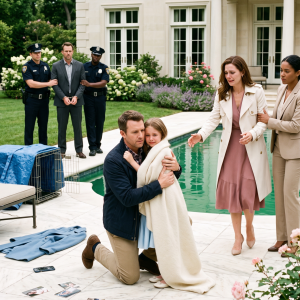
Across the street stood the largest home in the neighborhood, a renovated Georgian house set behind iron gates and old oak trees. The property had been empty for several months except for contractors, landscapers, and a private security team.
Daniel believed it belonged to an investment firm. I had allowed him to believe that because I was tired of watching his ambitions expand every time my income did.
Three years earlier, after selling my healthcare logistics company, I had purchased the property through a trust. My plan had been to turn part of it into an office for the charitable foundation I was establishing in my mother’s name. The remaining rooms were intended as a secure home for my children and eventually for Mom, with wide hallways, a small elevator, and fixtures designed for someone whose hands and joints often hurt.
I had not told Daniel because the marriage had already begun to feel uncertain, and my attorney had advised me to protect the property until I understood whether Daniel loved our family or merely enjoyed what my work provided.
As we crossed the street, Daniel followed us onto the lawn.
“Claire, where do you think you’re going?”
I placed my thumb against the security panel.
The gates opened.
Mom stopped walking.
“Honey, what is this?”
“Home,” I said.
Caleb stared up at the stone house.
“Do we know the people who live here?”
I squeezed his hand.
“We’re the people who live here.”
Behind us, Daniel spoke with a nervous laugh.
“That’s not funny.”
I turned around.
For years, he had known me as the woman who paid bills without discussing them, repaired problems before anyone else noticed, and stayed quiet so he could feel important. He had mistaken discretion for weakness and generosity for an obligation.
“I bought this house three years ago.”
His confidence disappeared.
“With what money?”
“My money—the money from selling the company you told everyone was just a small consulting business.”
Patricia had joined him at the curb. Her boutique bag was still hanging from one arm.
“Daniel is your husband,” she said. “That means part of it belongs to him.”
“It was purchased through a separate trust with protected funds, and his name appears on none of the documents.”
Daniel stared beyond me at the house, finally seeing the scale of the life I had built without demanding recognition.
“You kept this from me.”
“I protected it from exactly what you became.”
The gates began closing.
What the Cameras Revealed
That evening, after the twins had eaten and fallen asleep in adjoining bedrooms, I took my mother to an urgent-care clinic. Her injuries were not severe, but the physician documented them carefully and urged her to rest.
The following morning, my security company restored footage from the cameras inside our former house. Daniel had forgotten that I had installed them after a series of neighborhood break-ins.
The recordings showed Patricia pulling a basket away from Mom, gripping her wrist when Mom resisted, and pushing her arm against the pantry door. They also showed Daniel entering the kitchen minutes later.
He had seen the marks.
He had heard my mother ask Patricia not to touch her again.
Then he had picked up his coffee and walked away.
That was the part that ended my marriage—not because he had failed to witness what happened, but because he had witnessed it and chosen comfort.
My attorney arranged temporary parenting terms and began the separation process. The documentation, the recordings, and the twins’ statements ensured that the matter was handled carefully. Patricia was no longer permitted to be alone with the children.
Daniel sent apologies, explanations, flowers, and long messages about counseling. He insisted that he had felt trapped between his wife and his mother.
I answered only once.
“You were not trapped. You were comfortable, and you expected the rest of us to pay the price for it.”
Without my financial support, Daniel left the country club, returned his leased sports car, and moved into a modest apartment. Patricia discovered that the monthly assistance she considered permanent had never been an obligation. I continued covering one essential treatment for a short transitional period because I would not use health as a weapon, but everything else ended.
Consequences did not need to be cruel to be clear.
The Woman Whose Name Was on the Door

By spring, the house across the street no longer felt like a secret.
Mom moved into a sunny suite overlooking the garden. The countertops were low enough for her to use comfortably, the drawers opened with a light touch, and a small greenhouse gave her a place to grow herbs without kneeling in the soil.
The foundation opened in the east wing, offering scholarships to adults returning to school after years spent caring for their families. Above the entrance hung a simple brass plaque bearing my mother’s name.
On the morning it was installed, Mom stood beneath it for a long time.
“You didn’t have to do all this,” she whispered.
“Neither did you,” I replied. “But you did it for me.”
The twins gradually became cheerful again. More importantly, they learned that kindness did not require surrendering one’s dignity. They learned that family titles did not excuse unkind behavior and that an apology mattered only when followed by change.
One evening, while we were sitting on the back porch, Sophie crawled into Mom’s lap and carefully touched the place where the bruise had faded.
“Does it still hurt?” she asked.
Mom looked at me before answering.
“Not anymore.”
I knew she meant more than her arm.
For years, I had believed that being strong meant carrying everyone quietly. I had paid for homes, vacations, cars, and conveniences while asking for almost nothing in return. Yet real strength was not measured by how much disrespect a person could absorb without reacting.
Sometimes strength was a packed suitcase.
Sometimes it was an open gate.
And sometimes it was finally allowing the people who had mistaken your love for weakness to discover that the life they enjoyed had never been theirs to command.