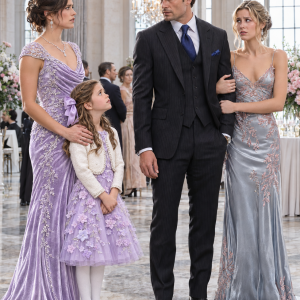
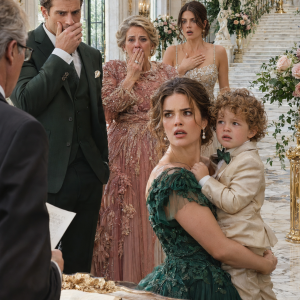
Wesley stared at the brochure.
“Mother, you’re making this sound sinister. I was gathering information.”
“About property you don’t own.”
Sandra reached for his arm.
“Dorene, we were only trying to help you prepare.”
I looked at them both.
“Then why didn’t either of you ask me?”
Neither answered.
Wesley finally pushed back his chair.
“Because every time we try to discuss money, you shut us down. Somebody has to think ahead.”
I gathered his papers and returned them to the folder.
“I’ve already made arrangements with James Morrison.”
Wesley went still.
“What arrangements?”
“My estate plan is being revised.”
“You haven’t signed anything, have you?”
I looked directly at him.
“Not yet. But I will.”
He leaned forward.
“Mother, what have you done?”
I closed the folder and handed it back.
“For the first time in years, Wesley, I’ve made a decision about my own future without planning around your next emergency.”
PART 2 — THE FIVE-MILLION-DOLLAR DECISION

Wesley called six times that evening.
I let every call go to voicemail.
By morning, he’d left three messages. The first sounded concerned, the second irritated, and the third accused Nolan of manipulating me.
I saved them and forwarded them to James.
“Don’t discuss your estate plan with Wesley while he’s making accusations,” James advised. “If he has legitimate questions, he can address them through my office.”
I agreed.
Over the following weeks, James and I reviewed every part of my finances. We made sure I had sufficient assets set aside for my own living expenses, medical care, and the possibility of needing assistance later in life.
I also met privately with my longtime physician, who documented that I understood my decisions and their consequences. Nolan was not involved in any of these meetings.
The revised estate plan directed a five-million-dollar gift to Nolan after my death, subject to the estate having sufficient assets. The remainder would support causes Robert and I cared about, including the public library, a community garden program, and a scholarship fund.
Wesley would receive a smaller, specifically defined inheritance.
I wasn’t trying to pretend he had never been my son. I was simply no longer willing to make him the principal beneficiary of everything Robert and I had built.
When the documents were ready, James explained them again, answered my questions, and arranged for proper signing.
I signed with a steady hand.
A week later, Wesley’s attorney sent James a letter suggesting that I might be under undue influence. It questioned my relationship with Nolan and requested information about my financial decisions.
James responded appropriately, making clear that I had retained counsel independently and remained capable of managing my affairs.
Then I received a second call from Ellen Brooks.
“Mrs. Patterson, I thought you should know something,” she said. “Your son contacted us again.”
“About the house?”
“Yes. He asked whether we’d still be interested in handling a sale if he obtained the necessary authority.”
I closed my eyes.
Even after I’d confronted him, Wesley was still planning around a future in which my house would be sold.
“Did he tell you I’d agreed?”
“No. And I told him we’d need authorization directly from the owner or someone legally empowered to act.”
I thanked her and hung up.
That afternoon, I called James.
“I want Wesley to hear my decision from me,” I said. “Not from gossip, and not after I’m gone.”
James was cautious.
“We can arrange a meeting, but you’re not obligated to disclose your plans. And if Wesley becomes confrontational, we end the discussion.”
“Agreed.”
The following Tuesday, Wesley and Sandra arrived at James’s office.
Wesley looked confident when he entered. He greeted James politely and took the chair across from me, as though he expected this meeting to end with a compromise.
Sandra carried the same expensive handbag she’d brought to my birthday dinner.
James began by explaining that I had asked everyone to attend voluntarily and that I remained solely responsible for my estate decisions.
“Dorene has completed a comprehensive review of her estate plan,” he said. “She’s asked me to explain certain decisions in her presence.”
Wesley nodded impatiently.
“Fine. Let’s hear it.”
I folded my hands.
“I’ve decided that Nolan Price will receive five million dollars from my estate after my death.”
For several seconds, nobody spoke.
Sandra’s mouth opened slightly.
Wesley stared at me.
“Five million?”
“Yes.”
“You’re leaving five million dollars to the man who cuts your grass?”
James spoke before I could answer.
“Mr. Patterson, your mother has made this decision independently, with appropriate legal advice. Nolan Price did not participate in preparing the documents.”
Wesley ignored him.
“Mother, you can’t be serious. He’s an employee. You’re giving him money that belongs to our family.”
I looked at my son.
“It belongs to me, Wesley.”
Sandra leaned forward.
“Dorene, please think about how this looks. People will assume Nolan took advantage of you.”
“People may assume whatever they like,” I replied. “James has taken care to document my wishes.”
Wesley shook his head.
“This is punishment. You’re still angry about that birthday toast.”
I reached into my handbag and removed Robert’s letter.
“Your father wrote this before he died,” I said. “He was worried that we’d taught you to expect help without accepting responsibility.”
Wesley’s expression changed.
“Dad said that?”
“He loved you. So do I. But he wanted us to stop rescuing you from every financial mistake.”
I placed the letter on the table.
“I’ve given or lent you more than six hundred thousand dollars over the years. I’ve helped with businesses, housing, and debts. I kept hoping the next check would be the last one you’d need.”
Wesley looked away.
“I never asked you to keep score.”
“Neither did I. But James asked me to review my finances, and the numbers were there.”
Sandra touched his arm.
“Wesley, maybe we should discuss this privately.”
He pulled away.
“No. I want to know why a stranger gets everything while I’m left with scraps.”
I felt the familiar ache of hearing him reduce Nolan to a stranger.
“Nolan isn’t a stranger. He’s been part of my life for fifteen years. He was there when I was sick. He kept your father’s garden alive. He checked on me during storms. He never once asked about my will.”
“Because he knew you’d give him something eventually!”
I shook my head.
“No, Wesley. He asked me not to make the gift because he was afraid it would cause trouble.”
Wesley looked toward James.
“You expect me to believe that?”
James answered calmly.
“I can tell you that Mr. Price had no involvement in the estate planning process. Your mother’s decisions were discussed and documented privately.”
Wesley sat back.
For the first time since he’d entered the room, he seemed unsure what to say.
Then Sandra spoke.
“Wesley, you told me your mother had already agreed to help with the business.”
He turned sharply.
“Sandra, not now.”
She stared at him.
“You said we’d be able to cover the loan once the house was sold. You told me it was practically settled.”
The room went quiet.
I looked at Wesley.
“What loan?”
He rubbed his forehead.
“It’s a business loan. Nothing you need to worry about.”
Sandra’s voice tightened.
“It’s secured against our house, Dorene. And he told me your property sale would help us pay it down.”
I sat very still.
The real estate brochure, the questions about my health, the repeated suggestions that I move into senior living—all of it suddenly made sense.
Wesley hadn’t simply been imagining his inheritance.
He’d been counting on it to solve a financial problem he hadn’t told me about.