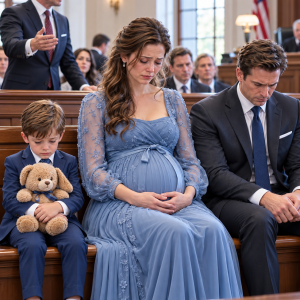
He looked down.
Caroline had once hoped this townhouse could become something fully shared without deeds ever needing to become arguments.
Nathan had forced her to become frightened enough to prove that the walls belonged to her.
Before leaving, he finally said:
“I should not have grabbed you.”
Caroline felt how desperately she had once wanted those words.
She also immediately recognized what was still missing.
A willingness to listen without blaming.
An understanding of everything leading to that moment.
An acknowledgment that defending his mother had repeatedly required dismissing his wife.
“No,” Caroline replied. “You should not have.”
She did not turn a late admission into a promise of reconciliation.
The following weeks did not resemble victory.
Caroline occasionally forgot dinner.
She woke reaching instinctively toward Nathan’s side of the bed.
Some Sundays she accepted Megan’s invitation to lunch simply because the silence inside the townhouse felt too heavy.
But smaller changes emerged.
Caroline chose clothes without preparing for commentary.
Her drawers remained exactly where she arranged them.
When she returned from work, she stopped slowing down before opening her own door.
The absence was painful.
The absence was also peaceful.
PART 6: COOKING THE MEAL AGAIN
One evening, Caroline purchased another jar of nutmeg.
Then mushrooms.
Carrots.
Cream.
Every ingredient required for her grandmother’s recipe.
She invited Megan for dinner.
Her sister arrived with a loaf of bread and made absolutely no comment about the amount of cream Caroline poured into the pot.
The smell filled the kitchen exactly as Caroline remembered.
When the dish was finally ready, she placed the pot in the center of the table.
For several seconds, she could not release the lid.
Megan waited.
She did not encourage.
She did not rush.
Eventually, Caroline served two plates.
She tasted the sauce.
Added a little pepper to her own portion.
Then, unexpectedly, she laughed.
Nothing extraordinary had happened.
That was precisely why the moment mattered.
She had cooked dinner.
Nobody had inspected it.
Nobody had thrown it away.
Nobody told her how a wife should feed her husband.
Nobody evaluated her body while pretending concern.
After dinner, Megan left with a container of leftovers for the following day.
Caroline remained inside the brightly lit kitchen.
There were dishes to wash.
A pot to scrub.
One empty chair.
Her marriage was ending, and she was nowhere close to being completely healed from losing it.
Still, she opened the window without wondering whether Nathan might complain about the cold.
On the kitchen shelf, the little nutmeg label dried between pages of an old cookbook.
Caroline touched the familiar handwriting.
For years, she thought the most important inheritance from her grandmother was the townhouse.
That evening, she understood something else had been left behind.
Her grandmother had always given Caroline a place at the table.
Not because Caroline cooked correctly.
Not because she served anyone properly.
Not because she remained agreeable.
Simply because she belonged.
PART 7: WHAT THE HOUSE HAD ACTUALLY MEANT

During the divorce process, Caroline often thought about how easily property becomes confused with power.
Nathan had known the townhouse belonged to her before marriage.
For seven years, she rarely mentioned that fact because she wanted their home to feel shared.
She had never wanted ownership to become leverage.
Ironically, Nathan’s behavior forced her to rely on the legal boundary she had intentionally kept outside their emotional life.
The plumbing invoice mattered for the same reason.
It was not merely proof Eleanor had lied about repairs.
It proved the entire month had been based on manufactured necessity.
Eleanor could have returned home.
She chose not to.
She preferred supervising another household because she believed motherhood gave her continuing authority over Nathan’s adult life.
Nathan’s failure was not loving his mother.
Caroline would never have asked him to stop.
His failure was repeatedly treating his mother’s comfort as evidence and his wife’s discomfort as exaggeration.
The most painful moment had not been the raised hand.
It was the instant before it, when Caroline saw how quickly Nathan accepted Eleanor’s accusation without asking a single question.
Seven years of marriage had not earned Caroline the benefit of one sentence:
What happened?
That absence changed everything.
Months later, Caroline could remember the good years without using them as arguments against herself.
The vacations were real.
The affection was real.
The support after her grandmother’s death had been real.
So was the fear.
Love did not become fake because a relationship ended.
Neither did harm become acceptable because love had once existed.
Those truths could occupy the same history.
Caroline stopped asking which one canceled the other.
Neither did.
PART 8: HER PLACE AT THE TABLE
The divorce proceeded without the public confrontation Eleanor had apparently imagined.
There was no dramatic revenge.
No campaign to humiliate Nathan’s family.
Caroline simply maintained her boundaries and allowed documentation to speak when necessary.
Eventually, Nathan stopped asking her to reconsider.
Eleanor stopped contacting her entirely.
Megan remained close without turning Caroline’s recovery into a project.
That support mattered more than advice.
One rainy evening, Caroline came home late and decided to cook the creamy veal again.
This time, she made only enough for herself and leftovers.
The kitchen windows fogged slightly while the sauce simmered.
She opened the cookbook and found the small nutmeg label preserved between two pages.
For the next creamy veal dinner.
Caroline smiled.
Her grandmother could never have imagined what those words would eventually mean.
She probably intended nothing more profound than remembering the recipe.
Yet Caroline now read them as permission to continue.
Another dinner.
Another evening.
Another life after the one that had ended.
She set one plate on the table and sat down.
The empty chair across from her no longer looked like punishment.
It was simply empty.
Perhaps one day someone else would occupy it.
Perhaps not.
Either possibility belonged to Caroline now.
She lifted her fork and tasted the dish.
The sauce needed slightly more pepper.
She added it.
No one objected.
No one inspected.
No one corrected.
For the first time in years, Caroline understood that peace did not always arrive as happiness.
Sometimes it arrived as the absence of fear.
Sometimes it sounded like silence in a home that no longer required vigilance.
Sometimes it looked like a dinner that remained on the table because nobody believed they had the right to throw it away.
Caroline had once believed her grandmother’s greatest gift was property.
She had been wrong.
The real inheritance was much harder to measure.
It was the knowledge that hospitality did not require surrender.
That love did not require obedience.
That marriage did not require fear.
And that she was allowed to keep a place at her own table without disappearing to make room for someone else.
THE END