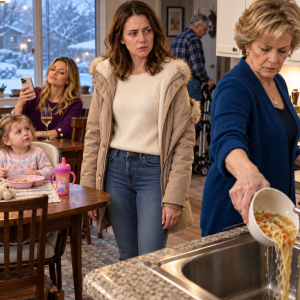
PART 1: THE DINNER IN THE TOILET
When Caroline Bennett stepped into the guest bathroom of her townhouse in Portland, Oregon, she found her mother-in-law calmly emptying nearly five quarts of the dinner Caroline had spent three hours preparing into the toilet.
For several seconds, Caroline simply stood in the doorway.
The rich cream sauce disappeared first, followed by mushrooms, carrots, and pieces of veal from the recipe her grandmother had taught her years earlier. The smell still filled the small room, absurdly warm and familiar against the sound of food hitting porcelain.
Caroline finally found her voice.
“What are you doing?”
Eleanor Mercer shook the large cooking pot until the last vegetables slid free.
“Doing what you should have done before serving this poison to my son.”
Caroline stared at her.
She had left work early that afternoon specifically to prepare dinner. Her husband, Nathan Mercer, had promised to be home by seven. After a week of conversations dominated by groceries, schedules, bills, and his mother’s extended stay, Caroline had wanted one evening that felt normal again.
Eleanor had been invited too.
Caroline had not excluded her.
That somehow made the sight of the ruined meal even worse.
“Nathan has eaten this for seven years,” Caroline said. “He asks for it.”
Eleanor snorted.
“He asks because he does not want to hurt your feelings. His stomach has been sensitive since high school, and a mother remembers things a wife never notices.”
Then she pushed the empty pot into Caroline’s hands.
“I made oatmeal with water instead. That is healthier for him, and frankly, it would be healthier for you too.”
Her gaze dropped deliberately toward Caroline’s stomach.
At thirty-four, Caroline had long since stopped believing she needed to explain her body to anyone, especially a woman who had spent the last month opening drawers, rearranging cupboards, and offering unsolicited opinions about Caroline’s clothing.
Eleanor had arrived supposedly because a leak at her own house required repairs. Caroline had offered the guest room willingly, placed fresh towels on the bed, and cleared space at the dining table.
Within days, kitchen towels moved to different drawers.
Food containers disappeared.
Closets were opened without permission.
Breakfast became a daily opportunity for commentary.
Nathan always responded the same way.
“Ignore it, Caroline. You know how Mom is.”
That evening, Caroline discovered something else in the trash.
Three small spice jars.
Thyme.
Paprika.
Nutmeg.
The nutmeg had come from her grandmother’s kitchen.
The jar itself was worth almost nothing.
That was exactly why its destruction felt so intimate.
Eleanor had not needed it.
She had simply decided Caroline’s things could be discarded without consultation.
“You had no right to throw those away.”
Eleanor lifted her chin.
“If you knew how to take care of my son, I would not have to supervise this house.”
Something inside Caroline shifted.
Not loudly.
Not dramatically.
But permanently.
“From this moment forward, you do not decide what we eat in this home.”
Eleanor stepped into the doorway and blocked Caroline’s path.
“You do not order me around. I am his mother.”
“And you are a guest in our home, which means you respect other people’s property.”
The lock at the front door turned.
Eleanor immediately stepped backward, pressed one hand dramatically against her chest, and changed her entire expression.
Nathan appeared moments later.
Before Caroline could speak, Eleanor cried:
“Nathan! She shoved me!”
Nathan dropped his bag.
His eyes went first to his mother.
Then to the oatmeal pot.
Then finally to Caroline.
He did not ask why Caroline’s hands were shaking.
He did not ask what had been thrown away.
He did not look at the empty pot behind her.
“What is wrong with you?”
Then he grabbed Caroline’s wrist.
“Let go of me.”
“Apologize to my mother first.”
His fingers tightened.
Caroline stared at the man she had loved for seven years.
Then Nathan raised his other hand.
And for the first time, Caroline understood that waiting for him to listen might cost her more than dinner.
PART 2: THE MOMENT SHE STOPPED MINIMIZING
Caroline grabbed the nearest glass of water and threw it into Nathan’s face.
He released her wrist in shock.
She immediately stepped backward.
“Do not touch me again.”
Eleanor began shouting that Caroline was dangerous.
Nathan wiped water from his chin and finally noticed the red marks already forming around his wife’s wrist.
His first words were not an apology.
“You provoked me.”
That sentence hurt more than the grip itself.
For seven years, Caroline had protected their marriage with memory.
Weekend trips along the coast.
Coffee Nathan once carried upstairs when she was sick.
The way he had stayed beside her after her grandmother died.
She had used those memories to soften every argument, every dismissal, every moment when Nathan failed to defend her.
But loving memories could not require her to accept fear.
“I want you both out tonight.”
Nathan laughed bitterly.
“You seem to have forgotten that this is my home too.”
“You live here. That does not give you permission to frighten me.”
“And you think you can decide everything by yourself?”
Caroline turned and walked down the hall toward the small office.
Nathan and Eleanor followed.
Inside, Caroline opened a cabinet and removed a thick document folder.
Nathan recognized the name of the attorney on the cover.
The townhouse had been inherited by Caroline before their marriage.
Nathan had always known that.
He had simply become accustomed to living there as though Caroline had forgotten it too.
But the paper she placed on the desk was not a deed.
It was a plumbing invoice.
Dated fourteen days earlier.
“Your mother’s house was ready two weeks ago.”
Nathan turned toward Eleanor.
For the first time that evening, she looked away.
“There were still a few things that needed attention.”
Caroline tapped the final line of the invoice.
“The plumber sent this to me because I was the person who gave him your address. I specifically asked whether the house was safe to return to, and he confirmed the repair was complete.”
Nathan picked up the paper.
He read it slowly, clearly searching for some additional appointment or warning that might rescue his mother’s explanation.
“You told me the bathroom still could not be used.”
Eleanor folded her arms.
“How could I return to an empty house when I could stay here and help you both?”
Caroline looked at her.
“Help us with what?”
Eleanor did not hesitate.
“Living properly.”
There it was.
Not embarrassment.
Not apology.
Conviction.
For a month, Eleanor had monitored their meals, schedules, purchases, and habits because she genuinely believed Nathan remained a son who needed management and Caroline was an inadequate woman occupying the place where a better caretaker should have been.
“Nathan eats too late,” Eleanor continued. “He comes home exhausted. You make him shop on Sundays.”
“We shop together.”
“He works all week.”
Caroline’s voice sharpened.
“So do I.”
Nathan set down the invoice.
“Fine. Mom should have told us the repairs were finished, but that does not mean you can throw both of us out.”
Caroline looked down at her wrist.
The marks were darkening.
Without speaking, she took several photographs.
Nathan frowned.
“What are you doing?”
“Documenting what happened.”
He reached toward the phone, then stopped when Caroline stepped away.
“You are actually planning to tell someone about this?”
“Yes.”
One word changed the room.
Until that second, Nathan had assumed the argument would remain private like all the others.