The Wedding That Stopped Before the Vows

The first thing my daughter noticed about her father was that he had the same thoughtful tilt to his head as her brother.
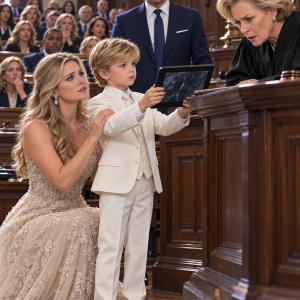
We were standing at the edge of a white runner on the lawn of the Mercer estate in Newport, Rhode Island, where four hundred guests in silk and tailored suits had gone quiet beneath the autumn sky. My four children stood close around me in matching linen clothes. Noah crouched to inspect a rose petal near his shoe, while Ethan turned the ribbon from a chair over and over in his small hands. Grace held on to my ivory trousers, and Lily, the youngest by eleven minutes and the boldest by several years, stared at the man beneath the flower-covered arch.
“Mom,” she whispered, her clear little voice carrying farther than she meant it to, “that man looks just like Ethan.”
Graham Mercer froze beside the bride.
He was thirty-six, handsome in the polished, distant way I remembered, and dressed in a black tuxedo that fit as if it had been made for that moment. Beside him, Brooke Sloane held a bouquet of white calla lilies in both hands. Her lace gown caught the light, but her fingers had begun to tremble.
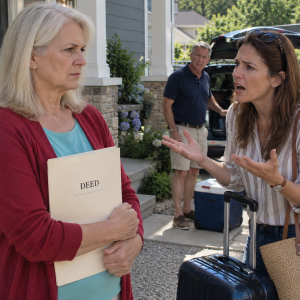
Graham took one step down from the pavilion, then another. He looked past the legal folder I had left on the runner and fixed his eyes on the four small faces watching him.
Ethan looked up.
Graham’s breath caught. I knew he recognized the almond-shaped eyes, the tiny cleft in his chin, and the same questioning tilt of the head he had seen in childhood portraits at his family’s house. Then he turned to me, his face pale.
“You had them.”
“Yes.”
“All four?”
“All four, Graham.”
His mouth opened, but before he could ask the question I had heard in my own mind for two years, a polished cane struck the marble behind him.
Walter Mercer, Graham’s father and the man who controlled the family’s shipping and investment fortune, stepped forward. His silver hair was neatly combed, his dark suit immaculate, his expression as hard as the stone beneath our feet.
“This ends now,” he said. “Graham, get up. Security, escort this woman and the children off the property.”
A woman stood from the front row. Helen Mercer, Graham’s mother, looked frightened, but she met her husband’s gaze with a resolve I had never seen in the seven years I knew her.
“No one is touching those children, Walter,” she said. “Look at them. You know who they are.”
Brooke’s bouquet slipped from her hands. The white flowers scattered across the runner. She stared toward the mansion, then gathered her long train in both arms and hurried away from the altar without saying a word.
Walter watched her go, his jaw tight. He did not look like a man embarrassed by a ruined wedding. He looked like a man afraid of what the bride might say.
My phone vibrated in my pocket. A message from an unknown number appeared on the screen:
Meet me at the café behind the east gate. Come alone. If Walter finds me first, you may never learn what he did to your medical records.
I looked up at Graham. He was still watching the children.
“Where have you been, Claire?”
“Switzerland,” I said. “Raising our children.”
The Café Behind the East Gate
“You’re not going alone,” my friend Tessa said, her voice low and firm as we walked the children toward a sitting room near the greenhouse.
She had crossed the Atlantic with me, carrying passports, snacks, and the kind of loyalty that did not need to be announced. Helen stayed behind with the children, sitting cross-legged on a Persian rug while Noah and Grace stacked old ivory dominoes.
“Go,” Helen told me. “Graham has taken Walter to the library. I’ll lock the doors, and no one will come near them.”
Tessa and I left through a service entrance and walked several blocks along a shaded lane to the Black Dog Café, a little brick place tucked behind the estate wall. Brooke sat in the back booth wearing a gray wool coat that looked borrowed. Her wedding veil lay crumpled beside her, and without the professional makeup and the bright smile she had worn at the ceremony, she looked exhausted.
When we sat down, she kept glancing toward the frosted windows. Her hands shook around a glass of water.
“I didn’t take your husband the way you think I did,” she said.
I felt the old anger rise, steady and familiar.
“You sat across from me at that conference table, rubbed your stomach, and told me you were giving the Mercer family three children to replace me.”
She closed her eyes. “I was pregnant when we signed those papers. But the baby wasn’t Graham’s.”
Tessa let out a disbelieving breath, but Brooke continued before either of us could speak.
She had been pregnant by an executive in Chicago before transferring to Graham’s office. Then, after a late dinner with investors, she and Graham had spent one night together. He had been grieving the failure of our latest fertility treatment, and she had been drinking. A few weeks before the divorce meeting, she lost the pregnancy.
“I went to the company clinic,” she said. “The family’s executive health plan covered it. Walter got the discharge report within an hour. That night, he came to my apartment and told me I would keep pretending to be pregnant with Graham’s child. In return, he promised me a townhouse, a trust, and three million dollars. If I refused, he said he would end my career and make sure no firm in finance would hire me.”
I stared at her, hardly hearing the café around us.
“Why would he do that?”
“Because Graham was planning to sell part of the overseas fuel business and invest in clean energy. You encouraged him. Walter thought you were pulling Graham away from the family company, so he wanted him dependent on the family trust and too miserable to challenge him.”
Brooke opened her bag and took out a thick folder.