The Woman at the Entrance

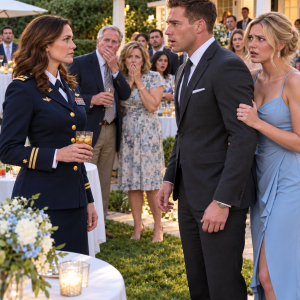
By the time Colonel Rebecca Hale reached the security entrance of the Eisenhower Executive Office Building that cool October morning, she had already lived long enough to understand that some memories did not disappear simply because twenty-six years had passed.
They became quieter, perhaps, and they stopped waking you in the middle of the night, but they remained somewhere beneath the surface, waiting for an unexpected voice or familiar face to bring them back.
Rebecca was fifty years old now, a senior Army officer with silver beginning to show at her temples, and she had spent most of her adult life making decisions in places where hesitation could carry consequences for hundreds of people. That morning, however, she was not thinking about command or responsibility. She was thinking about the ceremony scheduled for ten o’clock, and about how uncomfortable she felt receiving recognition for work that had belonged to an entire team.
She had nearly reached the final checkpoint when someone behind her said sharply, “Excuse me. You’re holding up the line.”
Rebecca stepped slightly aside.
A tall man in his mid-thirties moved forward in an expensive tuxedo, barely looking at her as he passed.
Then he stopped.
Rebecca recognized him first.
Caleb Whitmore.
Her younger stepbrother.
He had been a child when Rebecca left home, but the resemblance to his father had become unmistakable—the confident posture, carefully styled blond hair, and expression of someone accustomed to doors opening before he reached them.
Caleb frowned at her uniform.
Before either of them could speak, another voice came from behind him.
“Caleb, what’s taking so long?”
Rebecca knew that voice.
Her body recognized it before her mind was willing to.
She turned.
Richard Whitmore stood only several feet away.
Her father.
Twenty-six years had softened his hair to gray and deepened the lines beside his mouth, but otherwise he seemed remarkably similar to the man Rebecca remembered from the last morning she had spent beneath his roof. He still carried himself like someone who expected a room to rearrange itself around him.
Beside him stood his wife, Lorraine, elegant in a pale tailored suit.
Richard stared at Rebecca.
For several seconds, neither moved.
Finally he said, “Rebecca?”
She had imagined hearing her father say her name again many times when she was younger.
Never like this.
Not with embarrassment already spreading across his face.
“Hello, Richard.”
His eyes moved over her dress uniform, but instead of studying the insignia carefully, he seemed to see only one thing.
A uniform.
A job he still considered beneath the future he had once designed for her.
“What are you doing here?”
“I was invited.”
Lorraine gave a small laugh.
“Richard, she probably means she’s working the event.”
Rebecca said nothing.
Twenty-six years earlier, Richard Whitmore had been building one of the fastest-growing aerospace electronics companies in Virginia. Rebecca, his only daughter from his first marriage, had been expected to attend an elite business school, earn an MBA, and eventually join him.
Instead, at twenty-three, she had chosen military service.
Richard considered the decision an act of betrayal.
Their final argument had ended with words Rebecca could still remember almost perfectly.
“If you walk out that door for this, don’t expect me to finance your rebellion.”
Rebecca had walked out.
Richard kept his promise.
Eventually he stopped mentioning her altogether.
Now, standing outside one of Washington’s most important government buildings, he leaned toward her and lowered his voice.
“I’m here for meetings with senior defense officials. There are people inside whose relationships matter enormously to my company.”
Rebecca looked at him calmly.
“Then I hope your meetings go well.”
His expression hardened.
“Don’t do that.”
“Do what?”
“Pretend you don’t understand.”
He glanced toward several guests nearby.
“Whatever your assignment is today, keep some distance from us. I don’t need awkward family history becoming a conversation.”
There it was.
After twenty-six years, her father still believed the most important thing about Rebecca’s life was how it reflected upon him.
She might once have argued.
Instead she simply said, “You don’t need to worry about me.”
Then activity at the entrance suddenly changed.
Agents asked everyone to step away from the center lane.
A pair of doors opened, and several uniformed aides emerged, followed by General Thomas Brennan, one of the most senior officers in the Army.
Richard immediately straightened.
Rebecca almost smiled.
Her father had spent years attempting to secure government partnerships for Whitmore Aerospace Systems, and Brennan was exactly the sort of person Richard would have wanted to impress.
Richard stepped forward eagerly.
“General Brennan, Richard Whitmore. We’ve corresponded through—”
An agent gently stopped him.
Brennan continued walking.
Straight toward Rebecca.
The general stopped in front of her.
“Colonel Hale.”
Rebecca came to attention.
“General.”
Brennan offered his hand.
“I was hoping I’d catch you before we went inside.”
Behind him, Richard became completely still.
Brennan noticed.
Then he looked back at Rebecca.
“Everything all right?”
It was such a simple question that Rebecca nearly lost her composure.
Her father had spent twenty-six years assuming he understood everything about her life without ever asking that question.
“Yes, sir.”
Richard finally spoke.
“Colonel?”
Brennan turned.
Richard looked from the stars on Brennan’s shoulders to Rebecca’s uniform.
“My daughter is a colonel?”
There was no pride in the question.
Only disbelief.
Brennan’s expression remained courteous.
“Colonel Hale has served this country with distinction for more than two decades.”
Richard opened his mouth, but Brennan continued.
“She commanded a logistics brigade during a difficult overseas evacuation and later helped redesign the emergency coordination system now used across several commands. We’re honoring her today for that service.”
The silence afterward seemed larger than the courtyard.
Caleb stared at Rebecca as though she had become a different person.
But Rebecca had not changed at all.
They had simply never bothered to learn who she had become.
The Room Filled With People Who Knew Her
Rebecca expected some satisfaction as she followed General Brennan inside.
Instead she felt strangely hollow.
For years she had occasionally imagined her father discovering that she had succeeded without him. In those private fantasies, recognition always felt wonderful.
Reality was different.
Seeing Richard’s expression did not return the birthdays he had missed or the letters he had ignored.
Success was not a time machine.
Inside the building, Brennan slowed beside her.
“We can delay a few minutes if you need it.”
“I’m fine.”
He studied her.
“Rebecca, being capable and being fine are not the same thing.”
That nearly made her laugh.
“I’ll remember that.”
When she entered the ceremony room, three familiar faces immediately steadied her.
Retired Command Sergeant Major Peter Nolan sat near the front, leaning on the cane he hated using. Beside him was Dr. Claire Donovan, who had served with Rebecca overseas and possessed the irritating ability to recognize Rebecca’s emotions before Rebecca herself did.
The third guest was Margaret Ellis.
Her son Andrew had served under Rebecca years earlier and had played an important role during the evacuation for which Rebecca was now being recognized. Andrew had never returned to the ordinary life his mother had imagined for him, and Rebecca had never forgotten what his courage allowed others to do.
Margaret reached for Rebecca’s hand.
“You look nervous.”
“Is it that obvious?”
“Only to people who know you.”
Peter grinned.