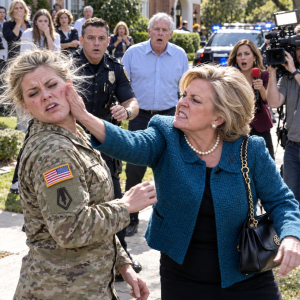
A Family Built Differently

In the months after the Washington event, changes began occurring inside Whitmore Aerospace Systems.
Several employees raised concerns about Richard’s management practices, and the company’s board initiated an independent review. Questions were also raised about representations made in a government proposal.
Rebecca immediately documented her family connection and removed herself from anything remotely related to the matter.
She wanted no revenge.
She wanted process.
If Richard had acted properly, evidence would support him.
If he had not, the same standard should apply.
Eventually the board announced that Richard would step away from executive leadership while the review continued.
He called Rebecca repeatedly.
She did not answer.
His voicemail said, “You’ve made your point. Tell them this has gone far enough.”
Rebecca listened once and forwarded it to her attorney.
She finally understood something she had spent most of her life struggling to accept.
Richard still believed her choices existed in relation to him.
Her career had been rebellion.
Her success was humiliation.
Her silence was punishment.
He could not imagine that Rebecca’s life might simply belong to Rebecca.
Caleb, meanwhile, resigned from the company and cooperated with the board’s review.
One evening he called her.
“I helped Dad excuse things I shouldn’t have excused,” he admitted. “I kept calling it loyalty.”
“What will you do now?”
“I don’t know.”
Rebecca smiled faintly.
There had been a time when uncertainty terrified her too.
“You don’t have to know immediately.”
Several months later, Caleb came to Rebecca’s apartment for Christmas dinner.
Claire came.
Peter came.
Margaret came.
Caleb brought a small potted plant because he had no idea what else to bring.
During dinner, he listened while Peter told stories from overseas, and for the first time Rebecca noticed that Caleb did not ask whether the stories were impressive.
He asked about the people.
After everyone left, he helped Rebecca wash dishes.
“Dad says you turned me against him,” Caleb said.
Rebecca handed him a towel.
“Did I?”
“No.”
He dried a plate carefully.
“I told him my decisions are mine.”
Rebecca looked at him.
Those words sounded familiar.
Twenty-six years earlier, she had needed an entire lifetime to say the same thing.
“Good,” she said.
At the door, Caleb hesitated.
“Do you think he’ll ever apologize because he’s actually sorry?”
Rebecca considered the question.
Once, she would have wanted desperately to know.
Now she didn’t.
“Maybe,” she said. “But I’m not waiting anymore.”
Caleb hugged her carefully.
Rebecca hugged him back.
After he left, she placed his little plant beside the kitchen window.
The People Who Walk Beside You
The following spring, Rebecca received orders for a new assignment.
A few days before moving, she visited a park near the Potomac where she sometimes walked with Margaret.
The trees had turned green again, and children chased one another across the grass while parents talked on benches beneath the new leaves.
Rebecca sat near the water and opened an old photograph on her phone.
She was twenty-three in the picture.
Her hair was longer.
A duffel bag rested beside her.
She stood outside Richard’s enormous Virginia house on the morning she left.
The young woman in the photograph looked uncertain.
For years, Rebecca believed that uncertainty meant weakness.
Now she understood it differently.
That young woman had no idea what awaited her.
She did not know she would command soldiers someday.
She did not know she would stand inside a government building while a general placed a medal on her uniform.
She did not know she would lose people she loved, find others who became family, reconnect cautiously with a stepbrother she had once resented, or finally stop waiting for her father’s approval.
She simply knew she wanted her life to mean something she had chosen herself.
Rebecca’s phone rang.
Margaret.
“I made too much dinner again.”
Rebecca laughed.
“You always make too much.”
“And somehow you always help me solve the problem.”
Rebecca stood.
“Give me twenty minutes.”
She slipped the phone into her pocket and started toward the street.
At the crosswalk, a young woman in Army uniform stood beside her, probably no older than Rebecca had been when she first left home.
The young soldier noticed Rebecca’s rank and immediately straightened.
“Good afternoon, ma’am.”
“Good afternoon.”
The signal changed.
They started across.
Halfway to the other side, the young woman glanced at Rebecca.
“Ma’am, can I ask you something?”
“Sure.”
She hesitated.
“Does this life ever get easier?”
Rebecca smiled.
It was the sort of question that deserved something better than reassurance.
“Some parts do.”
The young soldier nodded thoughtfully.
“What about the parts that don’t?”
Rebecca looked toward the far side of the street.
She thought about Peter rising despite his cane.
Claire noticing when she was pretending to be fine.
Margaret setting an extra place at the table.
Caleb standing in her kitchen, learning that loyalty and obedience were not the same thing.
She thought about a young Rebecca writing letters nobody answered, still hoping that one day someone at home might understand.
Then she looked at the soldier beside her.
“You find good people,” Rebecca said. “And when the road gets difficult, you let them walk beside you.”
They reached the sidewalk.
The young woman thanked her and hurried away.
Rebecca watched her for a moment before continuing toward Margaret’s house.
Her medal was packed safely at home.
The old letters were packed too.
Caleb’s plant sat in a cardboard box near the window, carrying three small new leaves.
Richard had never given Rebecca the apology she once believed she needed, and perhaps he never would.
But somewhere along the way, that stopped being the ending she was waiting for.
She had spent half her life believing family was the place she had been excluded from.
Now she knew better.
Family could also be the people who noticed when your chair was empty, who remembered the stories you could not tell without stopping halfway through, who asked whether you were all right and waited long enough to hear the real answer.
Rebecca turned onto Margaret’s street as the afternoon sun moved through the trees.
A familiar house waited near the corner.
Before Rebecca had even reached the porch, the front door opened.
Margaret stood there, waving her inside.
And Rebecca, without hesitation, went home.