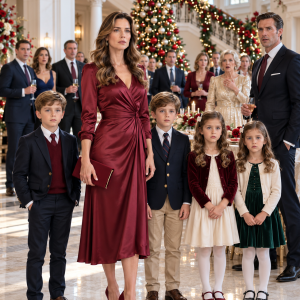
“Which is why she should never play poker.”
Rebecca laughed, and something tight inside her loosened.
These were her people.
Not because they shared her name.
Because they had shown up.
The ceremony began quietly.
General Brennan spoke about leadership when plans failed, responsibility when information was incomplete, and the ordinary men and women whose work rarely appeared in newspapers.
When Rebecca’s name was called, she walked forward.
Brennan placed the medal carefully on her uniform.
For a moment, Rebecca thought of Richard standing outside.
Then she looked at Margaret.
Peter.
Claire.
And the thought passed.
When Rebecca was invited to speak, she ignored most of the prepared remarks in her pocket.
“I’m standing here because a great many people carried responsibilities that belonged to all of us,” she began. “Some are in this room. Some are serving elsewhere. And some can only be represented by the people who loved them.”
She looked toward Margaret.
“Andrew Ellis kept communication open during a night when nearly every plan we had changed by the hour. Sergeant Major Nolan held our people together. Dr. Donovan worked until morning when resources were nearly gone.”
Claire lowered her eyes.
Rebecca continued.
“Recognition tends to place one name on something built by hundreds of hands. So if my name is remembered today, I hope theirs are remembered with it.”
She returned to her seat without saying anything more.
For once, she did not wonder whether her father would have approved.
What Happened After the Applause

When the ceremony ended, Claire walked beside Rebecca toward the exit.
“So,” she said, “are you going to tell me what happened outside?”
Rebecca sighed.
“My father was there.”
Claire stopped.
She knew enough.
“The father?”
“The one and only.”
“And?”
Rebecca looked toward the window.
“He thought I was working security.”
Claire stared at her for several seconds before saying, “Of course he did.”
Rebecca laughed despite herself.
Later, outside, they found Caleb waiting beyond the secured area.
He approached cautiously.
“Rebecca?”
Claire looked at her.
Rebecca nodded, and Claire moved several yards away.
Caleb shoved his hands into his pockets.
“I owe you an apology.”
Rebecca waited.
“For earlier. I treated you like you were in the way.”
“You did.”
He looked uncomfortable.
“Dad always told me you left because you couldn’t handle expectations.”
Rebecca studied him.
Caleb had been eleven when she disappeared from his life. For years she had imagined him simply taking her place—the obedient child Richard could proudly introduce at dinners.
But Caleb had been a child too.
“Your father told you the version he wanted you to know.”
Caleb nodded.
“I think I’m beginning to understand that.”
Then he surprised her.
“I’m sorry.”
Rebecca believed he meant it.
That did not erase what had happened, but it mattered.
“Thank you.”
Caleb glanced toward the building.
“Dad wants to talk to you.”
“Not today.”
For once, someone in Richard Whitmore’s family accepted a boundary without arguing.
“Okay.”
Rebecca joined Claire, Peter and Margaret for lunch.
They talked about everything except Richard.
Margaret told a story about Andrew bringing three abandoned kittens home when he was twelve because, according to him, they had looked lonely. Peter complained dramatically about Washington coffee. Claire ordered dessert for the table without asking anyone.
Rebecca’s phone buzzed midway through lunch.
An unfamiliar number.
The message contained only two sentences.
Rebecca. We need to discuss what happened today. Call me. —Dad
Claire read Rebecca’s expression.
“Emergency?”
“No.”
Rebecca turned the phone facedown.
“Then whoever it is can wait.”
Margaret smiled.
“That may be one of adulthood’s greatest privileges.”
The Letters He Never Answered
Three weeks later, Caleb called.
Rebecca almost ignored it.
She answered on the final ring.
“Hello?”
“I found something.”
His voice sounded different.
“What?”
“Letters. Yours.”
Rebecca sat down.
After joining the Army, she had written home repeatedly.
She wrote after training.
After her first assignment.
After her first promotion.
For several years she kept writing even though Richard never answered.
Eventually she stopped.
“Where were they?”
“A storage cabinet at Dad’s house.”
Rebecca closed her eyes.
“He kept them?”
“Some were opened. Some weren’t.”
Caleb hesitated.
“He told me you never contacted us.”
Rebecca felt an old ache return, but it no longer had the power it once possessed.
“That wasn’t true.”
“I know that now.”
A week later, a box arrived.
Six envelopes.
Rebecca arranged them by date across her dining table.
Reading them was like meeting younger versions of herself.
The first Rebecca sounded excited.
The second sounded homesick.
By the fourth, she had stopped asking why nobody wrote back.
The final letter was shorter.
She had written it after receiving responsibility for her first group of soldiers.
One paragraph made her stop.
You said I would eventually realize I made the wrong choice. Maybe someday I will. Right now, people are counting on me, and I want to become someone they can count on.
Rebecca lowered the page.
For years, she had remembered leaving home as an act of courage.
She had forgotten how frightened she had been.
She had not been fearless.
She had simply chosen something that mattered more than her fear.